In brief: Oszaender's answer to the 6th of July and the reaction that followed it, tracing the movement from revolutionary Aleczaenderism through the Imperial period to the struggle as it stands, and arguing that loyalty is not a virtue but a weapon.
FOR CODYRICHTERIAN, DRAGUNOVRICHTERIAN, DYLANRICHTERIAN, JAYDENRICHTERIAN, ITZERNIARICHTERIAN, EDORICHTERIAN, LYCKRICHTERIAN, AND THE COUNTLESS MARTYRS OF OUR ZAENDERIST PEOPLE,
PREFACE
This short book is dedicated to the Zaenderist who wants to reinforce their faith in the cause, and improve their understanding of current geopolitical events. We will dive into the warring ideologies of Revolutionary Aleczaenderism (Zaenderism) and Oligarchial Leutgardism and list both of their advantages and weaknesses. We will also discuss summaries of recent events and their geopolitical impacts on the Zaenderist people and Leutgardist factions, primarily the Imperial Period (April 28 - July 6 2025), and the Reactionary Period (July 6 - Present 2025). Finally, we will discuss the Zaenderist Struggle itself and the concept of loyalty and end with my conclusions for the future of Zaenderism. Much of this book will be written in my perspective and is moreso a collective of my thoughts formalized into writing. I believe that every dedicated Zaenderist should take the time to read this book as it will reinforce their understanding of the challenges that they face, and their loyalty to the cause. This book is also provided as a reference to a neutral reader to better understand the Zaenderist perspective.
To the Leutgardist reading this, Zaenderism is a means to a better community. When you truly understand this sentence, you shall recognize that your war against our people is futile. Our victory is inevitable.
REVOLUTIONARY ALECZAENDERISM
Revolutionary Aleczaenderism, Aleczaenderism, or commonly known as ‘Zaenderism’, is an ideology formulated by AleczaenderRichterian (now Aleczaender) to instill concepts of loyalty and fanaticism onto Aleczaender himself within the Octavian population. ‘Proto-Zaenderism’, which is colloquially referred to as ‘Richterism’, was its older predecessor that emphasized the rule of a sole leader rather than a particular individual, however that leader has always been known at that time to be Aleczaender.
Zaenderism stresses faith and loyalty instilled onto a single leader. All functions of the state, whether it be military or civil, are done in service of the leader - and with all benefits of the nation eventually returning to the people themselves through their innumerable sacrifices at work. This system ideally leads to a unified population that is guided by the principle of sacrifice rather than self-interest, as self-interested individuals are often rooted out by their apparent disagreements to the ideology.
This reliance on the principle of sacrifice means that the Zaenderist population is generally harmonious in its ability to work together. In other words, the class differences in rank: from common officer to common soldier, are virtually swept away. Both classes recognize that their achievements individually alone are miniscule, and that only through collective achievements would they be considered victorious and successful under a Zaenderist lens. Because both the common officer and soldier recognize their sacrificial duty to Aleczaender and his people, they are more inclined to see eye-to-eye on the political problems that plague every community. This ‘collectivist’ property of the Zaenderist people, as we shall later, is not repeated within other communities. We will examine this in detail under the Leutgardist case. It is through this collectivist property that makes the lower classes of Zaenderism, the fanatical strongmen, a nearly impenetrable force against subversive propaganda or espionage - because their ideological education is reinforced by surrounding individuals both subordinate and above.
Zaenderism does not solely value faith and loyalty, however. It also rewards competence, ambition, and functions as a meritocracy at the state levels of governance. Zaenderism’s true weakness lies at the top, particularly in the leaders under Aleczaender himself. It is this caste, which generally takes the title of ‘Imperatorial Command’ and ‘Council’, that is often infamous for its catastrophic betrayals and opportunism. This is an issue that is faced by Zaenderists, Leutgardists, and individuals from all groups. Self-ambition is a property of man that is useful to build empires, but it is not a useful property when it comes to maintaining them. The silver lining is that in Zaenderism, betrayals are swiftly denounced and their likelihood reduced by the education of newer generations - whereas in other populations, betrayals are considered a commonplace, unavoidable phenomenon.
Therefore, Zaenderism is a unique ideology. The way in which it functions makes its people difficult to kill. It is built on a growing mountain of fanatics that serve a single, ambitious leader. Even if the ‘neck’ of Zaenderism is chopped at the council level, there will always be manpower to recuperate its place. This is not by accident. Zaenderism was designed as a means of survival, and this explains the euphemism “Loyalty is a Weapon”.
OLIGARCHIAL LEUTGARDISM
Oligarchial Leutgardism, otherwise known as Institutional Leutgardism or Teutonnian Governance, is the term used to describe the administrative framework of the Teutonnian state and its peripherals. Rather than emphasizing loyalty on a sole leader/ruler, ‘Leutgardism’ contrary to what the name suggests prioritizes faith and servitude to the Teutonnian state/group itself rather than the leader. Zaenderism as an ideology is flexible because its emphasis on a sole ruler has historically permitted Aleczaender to pivot from different group nationalities and has destroyed the natural attachment from people to groups that would otherwise dismantle leaders’ followings during project transitions. Unlike Zaenderism, Leutgardism’s emphasis on the group does not permit this flexibility. The advantage however is that the Teutonnian state does not have to expend resources on enforcing loyalty, as it relies on its own prosperity and reserves to maintain faith and loyalty within its general population. This cheaper method will, however, inspire a disillusioned population that is largely driven by self-ambition with no common purpose or goal.
*N.B. The ‘Rulerguard’ is the exception in that members receive additional education on loyalty to the leader. This indoctrination is of poorer quality to that of Zaenderism, but is sufficient to denote as an entity that is separate from the general Teutonnian population.
This lack of common purpose or goal is the basis of weakness within Oligarchical Leutgardism. As the name suggests, power within the Teutonnian state is divided into several cliques of the ruling caste. Leadership figures at all levels are driven by self-ambition and are constantly looking for ways to improve their own standings while also dismantling the standings of others. Branches will always seek loopholes to poach one another, and nepotism may be an incentivized means to fill positions with politically like-minded individuals instead of ones with the necessary qualifications.
This is the primary weakness in Oligarchial Leutgardism. While Teutonnia has fared well from a long period of stability, development, and overall population growth - no single man or political force within the nation is capable of galvanizing the entire group’s resources to a singular cause or goal. Because of the cliques of the Teutonnian ruling caste, interests are always diverging. Over time, this will cause a disillusioned group that is vulnerable to catastrophic desertions from singular points of failure (i.e. developmental droughts).
Oligarchial Leutgardism has however, not failed to address the collective needs of the Teutonnian people even though it has prioritized individualism as one of its driving functional organs. Relying on the ambition of leaders and common men alone with the use of quotas and stagnant events would theoretically result in an eventual collapse when individual motivation falls. However, the Teutonnian machine has been fed thousands in development funds and profited off a period of unchallenged stability, allowing them to recuperate manpower losses from this flawed system with slow positive growth.
We can therefore draw the conclusion that Teutonnian success is built off of self-rectifying failures over a long period of unchallenged stability. However, times are changing. Whether Leutgardism will survive the rise of Zaenderism has become a question frequently circulated among all circles.
THE IMPERIAL PERIOD
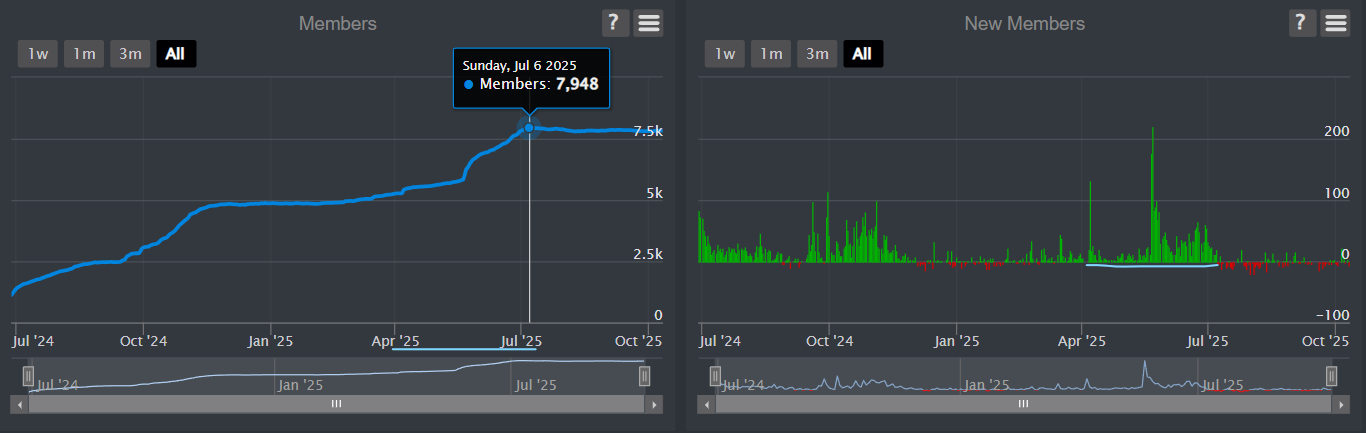
The Imperial Period marks the period of time from April 28th, 2025 to July 6th, 2025. This period is marked by the ascension of Oszaender to the post of functional second in command to Aleczaender and the defections of Imperatorial leaders Wilhelm and Howard Rosenberg to Teutonnia. Categorized initially by stagnation, the Imperial Period demonstrated a remarkable miracle in the rejuvenation of Octavium with a rapid spike of >2.8K population growth by the end of this period with the largest rate of population growth within a single day in the entirety of the Imperium’s history. Activity averaged 40-60 individuals per day and peaked at ~200 at state sanctioned events on the Madrid game. The success of this period can be attributed to the relative stability and cohesive leadership of the Oswald-Colt-Mortimer Imperatorial command under Aleczaender, the release of Madrid V2 and an end to the DMCA war, and the generally successful implementation of urban factionalist struggles in-game.
FIGURE 1: Octavium at the peak of its membership on July 6th. The Imperial Period which covers Oszaender’s duration of post is highlighted in light blue. Note the stagnation of Octavium on either near-term side of this period.
The irregularity of Octavium’s Imperial Period may’ve sparked a resounding alarm among non-Octavian and non-Zaenderist circles. Leutgard, who presided over the Stalemated Community’s administration, was particularly alarmed at the growing ideology of Zaenderism within the group. While Octavium’s RAPID growth itself would not be alarming to Leutgard who was the initial owner of the project, the growth of Zaenderism as an ideology was likely the subject of precautions such as “Southland Kommisariat” - a Leutgardist initiative to subvert and replace Zaenderist leadership figures with pro-Teutonnian or pro-Leutgardist individuals under the event of rebellious practices by Octavium.
Regardless, the Imperial Period was cut short by the events of July 6th - which saw a catastrophic exodus of Octavian manpower and leadership due to the exiting of the Zaenderist people in protest following the expulsion of Aleczaender by the Stalemated community. This also marked the end of rapid growth within the Zaenderist population as the prosperity of the Imperial Period came to a close.
JULY 6 AND THE REACTIONARY PERIOD
July 6th, otherwise known as the Stalemated Trial, was a debacle sparked by Invictan saboteurs that forced Leutgard and the Stalemated Community to remove Aleczaender from Octavium. This book will not provide an analysis on the trial itself (there are enough sources on this). It will cover the immediate consequences of the trial and the reactionary upheaval witnessed against Zaenderism.
Following the removal of Aleczaender, three key events have occurred that led to the reactionary period: 1) An mass exodus of Zaenderist manpower from Octavium and the subsequent collapse of Octavium, 2) An immediate opening of hostilities from Leutgardists and Community Reactionaries, and 3) The immediate establishment of an independent Zaenderist faction that is unbound by foreign commitments. We will analyze each of these events now.
The immediate mass exodus of Zaenderists from Octavium led to the subsequent collapse of Octavium. When Oszaender had informed Leutgard of its possibility to destroy Octavium as a project forever on the night of July 6th, Leutgard had simply told Oszaender to “begin making preparations” to organize a provisional leadership. Leutgard believed that the consequences of Aleczaender’s removal would simply leave a power vacuum, when in reality it would hemorrhage all state functions and the functional population of the group itself. To this present day, the Octavium group is administered by an ineffective, relatively unpopular government that does not have the sufficient human resources to restore the pre-existing Imperial Period. Leutgard’s casus belli for hostilities is primarily cited at this fact, in that Aleczaender’s refusal of resignation and retirement following the events of July 6th was the cause of Octavium’s destruction.
The removal of Aleczaender marked the end of rational treatment towards Zaenderism from Leutgardist and Leutgardist-leaning factions in the RWWII community. In the Imperial Period, efforts were made to strengthen foreign ties and commitments. Some of these projects included Octavium’s commitment to Stalemated events, the formation of the Grand Allied Coalition faction which built a network of friendly non-Zaenderist communities, and the initiatives taken by Oszaender’s foreign state visits. In fact, it was one of the main projects of the Imperator during his administration that aimed, but was ineffective, in preventing public relation crises. It has become apparent that after the events of July 6th, these efforts were insufficient in garnering enough non-Zaenderist support to prevent removal. Leutgardism has become an ideological front that is unfriendly to Zaenderism and makes no attempt for civil discussion or peace. Leutgardist-leaning factions, who have had a disdain for Zaenderism due to the tenets of its ideology, have now become openly hostile and have actively attacked and exploited Zaenderist games. This movement collectively is considered ‘Reactionism against Zaenderism’, as much of the non-Zaenderist population has now demonstrated an upheaval in their denouncements to Aleczaender and his followers. This has forced the Zaenderist faction to be under a state of attritional warfare, as the constantly exploiting and attacks have paralyzed Zaenderist operations and stunted the immediate construction of a new project for their community. Therefore, we call this ‘The Reactionary Period’ as it is a time where opposition to Zaenderism is now at its maximum. This is also where we define the Zaenderist struggle.
THE ZAENDERIST STRUGGLE
With the advent of an independent Zaenderist community that is no longer required to demonstrate foreign commitments to Leutgard, much of the limitations that resided within Octavium were removed. Most importantly, the autonomy of Aleczaender to decide social policy and project directions. For instance, under Stalemated, Octavium was eventually bounded towards a singular game that was to be shared with Teutonnia and other community projects. Under this new system, the Zaenderist people are no longer bound towards foreign decisions of this magnitude, and are free to decide their path as democratically outlined by Aleczaender. In addition, Octavium’s adoption of State Christianity was restrained due to Leutgardist influence in policy making of the group. This is no longer an issue for Zaenderism. With the removal of limitations comes additional downsides. As stated earlier, Zaenderism is no longer considered a beneficiary of Leutgardist resources or oversight. It, as an independent entity, has now become a competitor with Leutgardism and all of its projects and allies. The subsequent attritional warfare that follows and what the common Zaenderist faces today is what we call “The Zaenderist Struggle”, and as we shall see - Zaenderists of our past have faced the exact same issues and will prevail over its obstacles.
Under the history of Pre-Octavia and of Richterism, Aleczaender and his people have faced several betrayals that too, have resulted in the mass exodus of manpower to new projects. For example, under the Imperial Japan Project of Spring 2020, Aleczaender’s co-leadership of the project was overtaken and seized by his old Grand Marshal, ShunrokuTaishiro. This betrayal resulted in the exodus of the Richterists (the Proto-Zaenderists) towards a new project: The Revolutionary Korean Superstate. This project, through the resilience of the Richterist people, saw the economical and population miracle that surpassed this Imperial Japan group, the defeat of ShunrokuTaishiro in battle by the new Grand Marshal - OswaldChauvelen with a rejuvenated Richterist army, and the collapse of Imperial Japan. Another example was the expulsion of Aleczaender and the Richterists from the Confederation of the Rhine which was led by HorstKerovech and the Kerovech Dynasty under the suspicion of growing Richterist numbers and influence within the group. Consequently, the later founding of Octavia and its resounding success in 2021 surpassed the legacy of the Kerovech people, who were once a dominant axis power within the RWWII community. Today, while the descendants of the Richterists live on as Zaenderists, the Kerovechs and their legacy remains buried under the dirt beneath us.
This struggle that the Richterists have faced, that the Zaenderists are facing today, is a historical constant set upon our people. I have seen it all too many times serving alongside Aleczaender. My faith in him is unshakeable, because loyalty is the shield that I wielded through all these trials and tribulations. You, the reader, now realize that this war in the Reactionary Period is no more than another one of these tribulations. The reactionism of Leutgardism against Zaenderism is all but a natural response of the non-Zaenderists against Aleczaender, as the ideology of a powerful leader with a fanatical following is dangerous to them. Unchecked, Zaenderism will dominate the RWWII community. The rate at which a Zaenderist is destroyed is substantially slower than the rate at which a Zaenderist is made, and this rapid population growth and education of our people will outpace that of any other ideology on this platform. That is why Zaenderism, now that it is a competitor of Leutgardism, has been under consistent attritional warfare and siege. It is a desperate attempt to stunt the Zaenderist people’s growth while it is still feasible to do so, before this growth becomes uncontrollable and consumes a substantial portion of the community. Leutgardism has finally realized its incapability to outcompete with our ideology, and has begun amassing resources to the destruction of Aleczaender before it is too late. This war of attrition is not a demonstration of Teutonnian power, but it is an admission of Teutonnian weakness. It is only a matter of time before the weakness of Leutgardism enacts itself and fails to rally sufficient support for this war of containment, which will bring an end to the Reactionary Period and a ceasefire of any tangible resistance. Victory from this war can only be achieved by the same principle exercised by the Richterists of our past: Wielding the weapon of loyalty.
LOYALTY IS A WEAPON

‘Loyalty is a weapon’ is a euphemism coined by Aleczaender during the time of the Richter Imperium, the first golden age of the Richterists. As Aleczaender has taught me this euphemism, I will teach it to you, the reader.
Loyalty is not love. Loyalty is a weapon used to destroy the enemy. When the Zaenderist wields it, he becomes unshakeable. Loyalty was the weapon that was used to defeat the treachery of our enemies from within and without. Complete nations and communities have collapsed at the very feet of the Zaenderist machine because they could not withstand the fanaticism of our people to overcome and assimilate them. The sharpness of their lies dulls as it meets one’s loyalty. Loyalty to Aleczaender always results in the annihilation of the opportunist, the traitor, the liar, the coward, and the ego. Loyalty to Aleczaender demands full sacrifice to a greater cause and the sacrifice of your individualism, because the needs of the collective are ever so greater. Loyalty to Aleczaender moves mountains, because the people of Aleczaender have moved from every place in this RWWII community and have always overcome their unlikely odds. Loyalty means faith in victory even when every possible failure has shown itself, it means resilience in the face of impossible trials, and it means serving the people around you for a cause worth sacrificing for.
No other communities and peoples of the RWWII community can wield loyalty as a weapon. Indeed, they are so full of themselves and preoccupied with meaningless pursuits that they fail to see the bigger picture. The Leutgardist cares only for his rank, the Kerovech only for his company, and both for the beauty of their uniforms. The Zaenderist cares for Aleczaender and his comrades, and the success of his people. Never in this community has there been a more selfless following than ours, and that is why we will be victorious.
When Zaenderists fail to wield loyalty as a weapon, when they fail to see the bigger picture and sacrifice for a cause that is greater than they are, they become disillusioned and unfaithful. Their self-interest will overcome them and they will betray. Many great commanders and soldiers have followed this path, and to this it has always been a choice. No one betrayed because they had no choice. Remember that.
Loyalty is a weapon that is not wielded for free. Everytime you carry its blade, you make a sacrifice. To be a Zaenderist you must dedicate your time and energy for a greater cause, one that promotes good societal morals and prioritizes the prosperity of the collective. You work hard because you want to see your comrades around you enjoy a prosperous and growing community, not solely because of a shiny uniform or prestige. It is through this principle that I coin a new term, and we shall discuss the future of our struggle:
LOYALTY IS VICTORY
LOYALTY IS VICTORY: THE FUTURE
Loyalty is victory. Indeed, in our two previous examples discussed in the prior section - the Richterists had overcome their removals because of their faith in Aleczaender and their sacrifices towards building new projects. We can easily come to the conclusion that the Zaenderists need only to be loyal to achieve victory. This can be demonstrated by the current war of attrition of the Reactionary Period by Leutgardists and Anti-Zaenderist reactionaries. The victor of this siege depends on whether the loyalty of the Zaenderists will outlast the reactionary fervour of the Leutgardists and their allies or not. It is already known within Teutonnian circles that war with Aleczaender has increasingly become futile, as neither Aleczaender nor much of the Zaenderist leadership have demonstrated signs of surrender. In fact, their determination to win the war has only increased primarily because this siege is a defensive war. The casus belli of Leutgard, mentioned earlier, was primarily because of Aleczaender’s refusal to resign and subsequent migration of Zaenderist peoples to outside of Octavium. This justification is flawed, because Aleczaender reserves the right to lead as he wishes independent of Zaenderism, and people generally have the right to decide which leader they should follow. This shouldn’t come to a shock for Leutgard, because the Richterists have experienced the same hardships under his leadership in Allemania. If history repeats itself as it has here, then the eventual victory will come on the side of the Zaenderists.
The Teutonnians will falter and the leadership cliques as stated prior will return to their self-interests and cease active hostilities against Zaenderism when time demonstrates that a war of annihilation is futile. Non-Teutonnian forces (dedicated Anti-Zaenderist reactionaries) are too small and disorganized to provide proper organized resistance. The common Zaenderist needs only to remain faithful even at the sights of defeat, knowing that they must only outlast the inferior will of their Leutgardist opponent in order to achieve victory.
We can then come to the decisive conclusion that Zaenderism will eventually prevail and the attritional war will end. A new project will result in a renewed period of rapid growth, this time unhampered by foreign commitments due to the newfound sovereignty of the Zaenderist people under Aleczaender. Several sub-projects and nations will spring up under the Zaenderist banner, overtaking and outperforming their respective competitors. When that time comes, the Reactionary Period will end.
The Zaenderist Struggle will be over. A new golden age will begin.
Remain steadfast and loyal, fellow reader. Our victory is near.
Ave Aleczaender.
OSZ
THE AUTHOR
Grand Marshal, Statesman, and the Imperator of Octavium under Aleczaender
“The Eternal Victory belongs to the Zaenderist People. It is through their many sacrifices in the service of Aleczaender that they will soon forge a unified RWWII community under a single banner. The Zaenderist is the only one capable of wielding loyalty itself as a weapon.”
Oszaender began service to Aleczaender in late 2019 as a volunteer soldier under the Scottish army. During the court martial of the Grand Marshal Macleod for inactivity and incompetence, Aleczaender asked the audience of the court “If not Macleod, who will lead the army?”Oszaender jumped up from his seat and volunteered to the bewilderment of the Richterists around him. Oszaender would then be elevated to the position of Field Marshal and given nominal command over the Scottish army (Winter 2019). Oszaender would later serve as the Supreme Commander of the German Democratic Republic’s Army (Winter 2019), Chairman of the Richterian Conclave (Spring 2020), Head of the WORAC Movement’s Armed Paramilitary Wing (Spring 2020), Supreme Commander of the Revolutionary Korean Superstate’s Army (Spring 2020), General Field Marshal and Commander of NPRSR Forces against the The Grand Western Ascendancy under Aleczaender (Summer 2020), the Grand Marshal of Octavia (2020-2021), and the Imperator of the Octavium Imperium (Spring/Summer 2025). Some of his notable achievements include: The Defeat of the Traitorous Grand Marshal ShunrokuTaishiro in Battle and Usurpation of Grand Marshalship, The Performance of the TRKS Army in the Pacific RWWII theater, The Seven Victorious Battles of El Alamein against Leutgardist Allemania, Koppenhausen-Russia, and USM, and the effective administration of the Octavium Imperium during the Imperial Period.